
One of the most counterintuitive findings to come out of political psychology research in the last two decades is the backfire effect: the observation that, under certain conditions, correcting a person’s false belief does not just fail to change their mind. It makes them hold the false belief more strongly than before the correction. If this is real and reliable, it has fairly dark implications for anyone hoping that more facts and better information will fix the problem of political misinformation.
The original research, conducted by Brendan Nyhan and Jason Reifler and published in 2010, found evidence of the effect in experiments where participants received corrections to false political claims. Participants who already held a belief corrected by factual information sometimes increased their confidence in the false belief after receiving the correction. The researchers argued this happened because the correction triggered defensive cognition: people felt their identity was under attack and doubled down.
The research got enormous coverage. It resonated with a lot of people’s intuitions about why arguing on the internet feels futile. It spawned a genre of journalism about the futility of fact-checking.
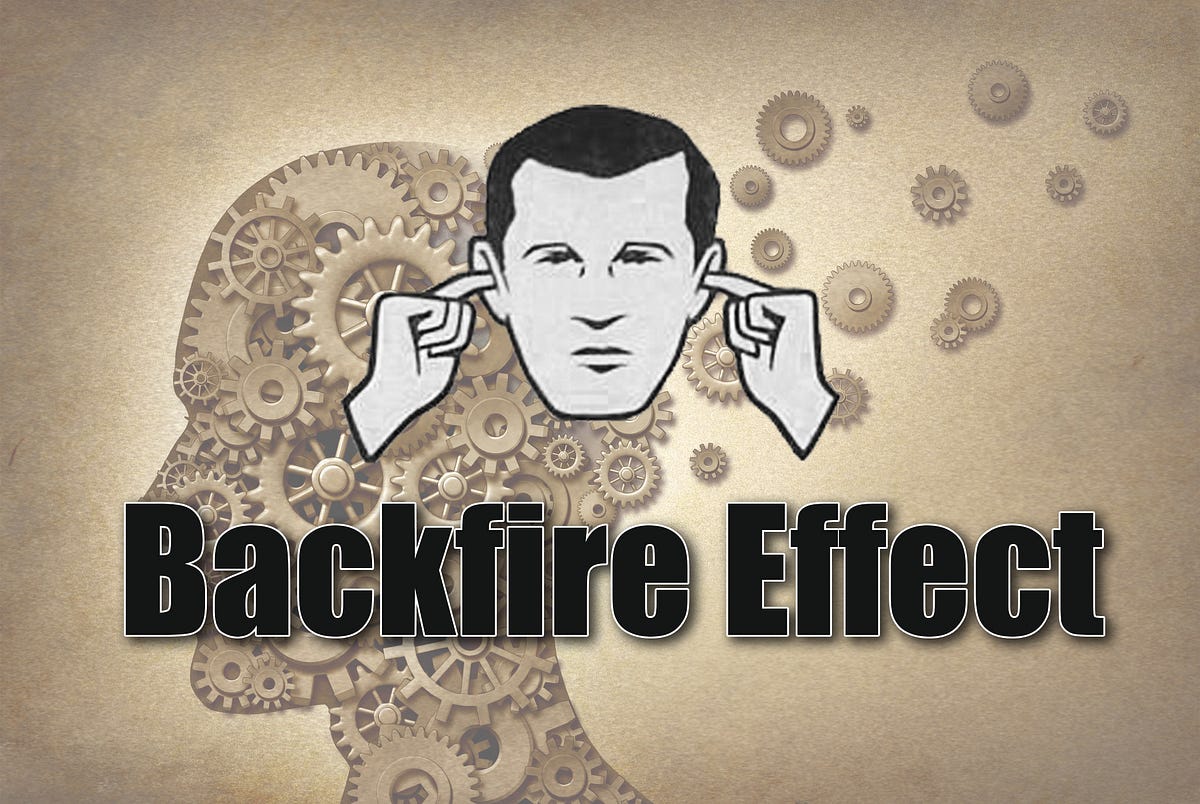
Here is where it gets complicated. Subsequent research has struggled to replicate the original findings consistently. Studies attempting to reproduce the backfire effect in different contexts have often found that corrections simply have no effect on the false belief, or in some cases do work. The consistent large backfire effect of the original paper appears to be much more conditional than originally presented, dependent on the specific topic, the specific framing, and the specific population tested.
What the more recent, more carefully designed research suggests is something more nuanced. Corrections often fail. They rarely backfire dramatically. The backfire effect, if it exists at all, appears to be limited to highly identity-laden beliefs in highly polarized contexts, not a general feature of how people respond to factual information.
Econora’s examination of the backfire effect literature, including the studies that failed to replicate the original findings, and what conditions seem to produce genuine belief change versus resistance, paints a more complicated picture than the simple “corrections always backfire” narrative that became popular.
The practical implication is somewhere between the naive view (just give people correct information and they will believe it) and the nihilistic view (corrections never work and may make things worse). Corrections work better when they come from trusted sources within the corrected person’s own social community. They work better when they are delivered without condescension and without any signal that the person being corrected is stupid or bad for having believed the wrong thing. They work better when they do not directly attack the corrected person’s identity or group membership. And they work better when delivered in contexts of genuine dialogue rather than public performance.
None of that is easy. But knowing the conditions under which corrections work is more useful than either “just provide facts” or “nothing works.” The goal is not to win the argument. The goal is to actually change what someone believes, and those two things require different strategies.